
KK 2.1.5 Flight Control Board Flight Controllers VTOL V-Tail Self-Balancing Aerobatics For FPVRacings Drones Flight Controllers
5.0Editor score
Affordable pricing
VTOL specific tuning
Simple self leveling
This expert guide compares the top flight controllers for hybrid VTOL and VTOL drones. We review features, firmware support, and compatibility to help you
Choosing the right flight controller is critical for hybrid VTOL and VTOL drones. These systems require precise control during vertical takeoff, transition, and fixed-wing flight. A reliable controller ensures stability, safety, and performance across all flight phases.
We compared ten top-rated flight controllers based on processor power, firmware support, and sensor suite. Our analysis covers open-source options like PX4 and ArduPilot alongside proprietary boards. We evaluated connectivity, ESC compatibility, and build quality to build this definitive list.
Each pick highlights specific strengths for hobbyists, researchers, or commercial users. Note that prices change frequently and stock varies by region. Always check current specifications before purchase to ensure compatibility with your specific airframe and battery configuration.
5.0Editor score

4.8Editor score
The following table provides a side-by-side comparison of all ten flight controllers. We highlight key specifications like processor type, supported firmware, and sensor suite to help you quickly identify the best option for your hybrid or pure VTOL build.



The Pixhawk 2.4.8 PX4 is an open source master controller ideal for complex hybrid VTOL builds. It supports fixed wing, multirotor, and custom platforms via rich function modules. Its high-end configuration features a 32F427 ARM Cortex M4 Core processor paired with a fail-safe co-processor.
We may earn a commission when you buy through this link, at no additional cost to you.
This controller is perfect for secondary development and researchers needing robust customization. The quick start guide assists new players with basic assembly and calibration. It connects to motors, servos, cameras, sensors, and microcomputers to enable true autopilot or remote driving capabilities.
While the open source nature demands technical skills, the quality assurance process ensures reliability. It includes a 3-month free repair or replacement policy if issues occur. The fail-safe co-processor adds a critical layer of protection for autonomous flight operations.
Choose this controller for academic or commercial projects requiring deep customization. It balances advanced processing power with accessible tools for hobbyists ready to learn. The included GPS module simplifies setup for immediate autonomous waypoint missions and return-to-home features.
Users can carry out secondary development with rich function modules and open code.
Quality inspection before shipment ensures reliability for critical autonomous missions.
We may earn a commission when you buy through this link, at no additional cost to you.
The KK 2.1.5 Flight Control Board ensures excellent stability for VTOL and V-tail aircraft. It features advanced self-balancing technology that simplifies takeoffs and landings for pilots. The board allows you to explore flight control systems and perform challenging maneuvers safely.
We may earn a commission when you buy through this link, at no additional cost to you.
Suitable for enthusiasts seeking advanced control without excessive cost, this controller supports self-leveling and acrobatic flights. It ensures stability and flexibility in different flight occasions ranging from photography to competitions. Its capabilities are tailored for showcasing flight skills effectively.
The main trade-off is the simplicity of the configuration software compared to high-end autopilots. However, for hobbyists focusing on VTOL aerobatics this limitation is acceptable. The board provides exceptional flying experiences through reliable and direct control inputs.
Buy this board if you want an affordable entry into VTOL flight dynamics. It is perfect for model aircraft competitions and aerial photography projects where cost efficiency matters. The self-balancing mode helps new pilots master hybrid transitions quickly.
Specifically tuned for vertical takeoffs and landings on VTOL and Vtail aircraft.
Allows you to explore flight control systems and perform challenging maneuvers.
We may earn a commission when you buy through this link, at no additional cost to you.
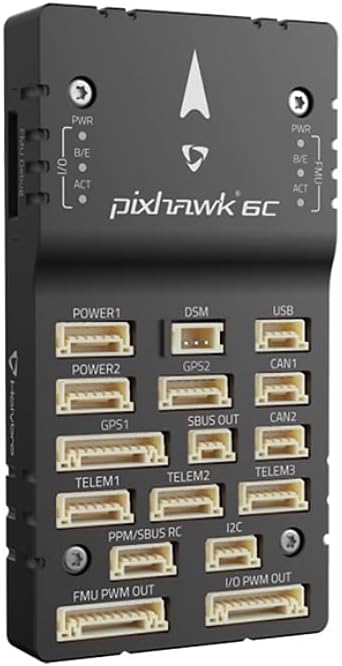
The Pixhawk 6C Flight Controller delivers massive computing power for complex autonomous vehicle algorithms. It uses a powerful 32-bit STM32H743 ARM Cortex-M7 core running up to 480MHz. This ensures efficient and productive development work for academic or commercial projects.
We may earn a commission when you buy through this link, at no additional cost to you.
Dual redundant IMUs from Bosch and InvenSense provide unmatched reliability with integrated temperature control. An engineered vibration isolation system filters high frequency noise to guarantee precise sensor readings. Pre-installed PX4 Autopilot simplifies initial setup for UAV deployments.
The low profile plastic case weighs just 34.6g for easy integration into small airframes. While opening the casing is required to switch PWM signal modes, the hardware switch offers wide peripheral compatibility. The ultra-low profile design suits both research labs and commercial applications.
Choose this controller when precision and reliability are non-negotiable. It offers cost-effective design compared to other enterprise grade units. The combination of redundant sensors and vibration isolation ensures flight stability in challenging environments.
Dual redundant IMUs with temperature control allow consistent optimum temperature work.
Effectively filters out high frequency drone vibration to reduce sensor noise.
We may earn a commission when you buy through this link, at no additional cost to you.
The PIX 2-12S Mavlink controller supports 2 to 12S power supply making it ideal for high voltage builds. Its core board features an STM32F405VGT6 controller with integrated gyroscope, magnetometer, and barometer for accurate telemetry. It supports SBUS, PPM, and CRSF receivers via a GH1.25 connector.
We may earn a commission when you buy through this link, at no additional cost to you.
With dimensions of 39×39×12 mm and 15g weight, this board fits compact autonomous driving systems or roaming vehicles. The basic wiring may include absorbers depending on the batch. It is suitable for use as the core board for PIX multi-rotor or fixed-wing VTOL projects.
Note that ESCs are excluded from the package so you must supply compatible units separately. The 30.5×30.5 mm M2 mounting hole spacing aligns with standard stack layouts. This ensures flexibility for DIY builders requiring custom power configurations or sensor setups.
Select this board for advanced DIY builds needing high voltage efficiency. The integration of essential sensors simplifies wiring for complex sensor payloads. It serves well for researchers or enthusiasts developing custom autonomous driving logic.
Supports 2 to 12S power supply for high performance motor applications.
Integrated MPU6500 gyroscope and VCM5883L magnetometer for accurate data.
We may earn a commission when you buy through this link, at no additional cost to you.
The COREWING F405 V2 Flight Controller is designed to fit both RC airplanes and drones. Its F405 processor provides sufficient processing power for standard flight modes in fixed wing and multirotor configurations. The compact design helps maintain aerodynamic profiles during high speed flights.
We may earn a commission when you buy through this link, at no additional cost to you.
Specific hardware capabilities are not fully detailed in the provided listing. However the name suggests broad compatibility with standard RC receiver inputs and ESC protocols. This makes it a flexible option for builders who transition between fixed wing and rotors.
The lack of detailed specifications requires careful checking before purchase. Users should verify pinouts and compatibility with their specific firmware preferences. It offers a straightforward solution for those seeking a single board for multiple airframe types.
Choose this controller for basic hobby builds requiring simple transition capabilities. It balances cost and functionality for general aviation projects. Verify receiver compatibility before installation to ensure seamless operation.
Designed to fit RC airplanes and drones for versatile hobby use.
We may earn a commission when you buy through this link, at no additional cost to you.
The F405 Wing Flight Controller is designed for fixed-wing drones with VTOL capabilities for versatile flight modes. It supports Ardupilot firmware allowing advanced customization and performance tuning for specific airframes. Users can configure and monitor flight parameters easily via a smartphone APP.
We may earn a commission when you buy through this link, at no additional cost to you.
With its F405 processor, this board ensures fast and stable responses during smooth flight experiences. It is ideal for both beginners and experienced pilots due to its user-friendly setup and extensive features. The compact design minimizes added weight while maintaining robust functionality.
While the APP control simplifies setup, relying on a smartphone connection may limit field adjustments. This makes it best for users comfortable with mobile management tools. The versatility for different builds offers flexibility for various drone models.
Pick this for hobbyists prioritizing ease of configuration over complex telemetry. The ArduPilot support ensures community-driven improvements. Always test APP connectivity before actual flights to ensure reliable remote monitoring.
Users can easily configure and monitor flight parameters via smartphone APP.
We may earn a commission when you buy through this link, at no additional cost to you.
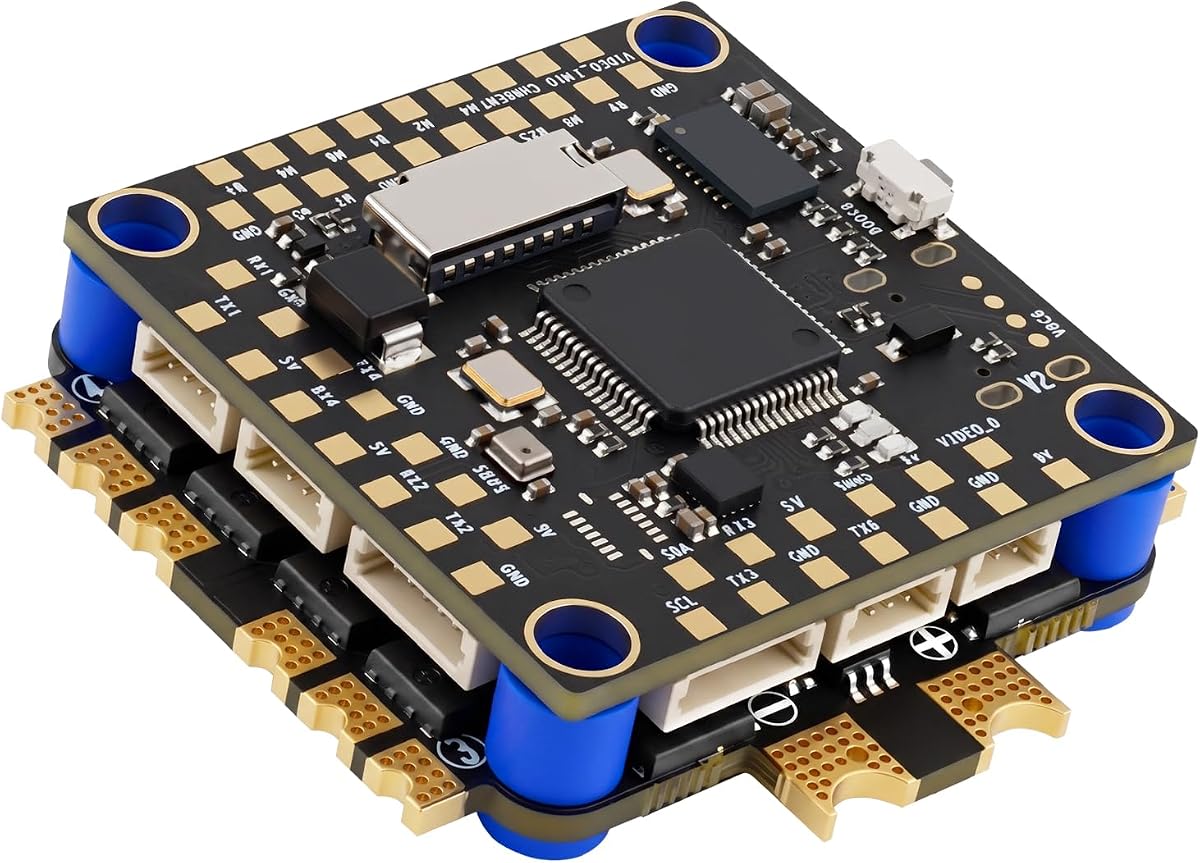
This H743 Flight Controller and ESC combo features a CORVON STM32H743 processor running at 480MHz with dual IMUs. The 60A 4IN1 32-bit ESC provides optimal power with over 80A burst current for high-performance drones. It supports Betaflight, PX4, INAV, and Ardupilot for quick configuration options.
We may earn a commission when you buy through this link, at no additional cost to you.
With 7 UART ports and 10 PWM outputs, this stack offers vast expansion potential for GPS and cameras. The compact 30.5×30.5mm mounting pattern fits wide variety of drone frames efficiently. Its lightweight total weight of 23.2g ensures easy installation for racing and FPV builds.
The dual IMUs provide superior stability during aggressive maneuvers. While the stack is heavier than lighter F4 alternatives, the raw performance justifies the tradeoff for demanding applications. Always check your frame size constraints before purchase.
Choose this stack for high-thrust racing builds needing full autonomous capabilities. The 2-8S support handles high voltage LiPo packs effectively. Ensure your firmware version matches all peripheral sensors for stable flight.
Delivers burst current of over 80A ensuring optimal power and stalling protection.
We may earn a commission when you buy through this link, at no additional cost to you.
This stack features the CORVON H743 Flight Controller with a 480MHz STM32H743 processor and 2MB Flash paired with a 50A 4in1 ESC. It delivers 50A continuous current per channel and supports 2S-6S lithium batteries for mid-range builds. The ESC supports DSHOT and ONESHOT protocols for precise throttle response.
We may earn a commission when you buy through this link, at no additional cost to you.
The 30.5×30.5mm mounting pattern ensures compatibility with a wide range of frames. Its total weight of 21.5g simplifies assembly and enhances efficiency. The 7 UART ports and OSD support allow flexible sensor and peripheral integration.
The 8-bit ESC limits current handling compared to 32-bit stacks. However for standard racing or aerobatic builds this power is usually sufficient. The lightweight design makes it attractive for airframes requiring minimal mass.
Select this option for balanced performance without excessive cost. It suits hobbyists needing reliable control for 6S setups. Verify battery voltage limits to avoid damage during high load operations.
High-frequency PWM, DSHOT, and ONESHOT protocols ensure precise throttle response.
We may earn a commission when you buy through this link, at no additional cost to you.
The AERO SELFIE F405NC Flight Controller features an STM32f405 processor and dual IMUs for superior motor control. It is compatible with O3 O4 AIR interfaces, making it ideal for modern HD FPV systems. The 60A 4IN1 ESC supports 2S-6S LiPo batteries with continuous 60A per channel.
We may earn a commission when you buy through this link, at no additional cost to you.
With 6 UART ports and DPS310 Barometer support, this stack offers vast expansion potential for telemetry and cameras. The compact 30.5×30.5mm mounting pattern fits a wide variety of frames efficiently. Its lightweight total weight of 23.2g ensures easy installation.
The 8-bit ESC may limit burst current compared to 32-bit options. However for racing and aerobatics this performance is usually acceptable. The video integration simplifies wiring for premium FPV builds.
Choose this stack for high definition FPV setups needing a lightweight solution. The ArduPilot support ensures compatibility for autonomous projects. Verify battery voltage requirements before connecting to avoid damage.
Compatible with O3 O4 AIR interfaces for modern HD FPV system integration.
We may earn a commission when you buy through this link, at no additional cost to you.
The AERO SELFIE H743 Flight Controller features an STM32H743 processor and dual IMUs alongside a 60A 32-bit ESC for superior motor control. It supports Betaflight, PX4, INAV, and Ardupilot for quick configuration options. The 30.5×30.5mm mounting pattern fits wide variety of frames efficiently.
We may earn a commission when you buy through this link, at no additional cost to you.
With 7 UART ports and CAN support, this stack offers vast expansion potential for GPS and cameras. Its lightweight total weight of 23.2g ensures easy installation. The 32-bit ESC provides better efficiency and precision compared to 8-bit alternatives.
While the rating is lower than other stacks, the raw performance is competitive for high-end builds. Users may need to verify firmware configuration for specific hardware compatibility. The design minimizes added weight while maintaining robust functionality.
Select this for high voltage racing builds needing full autonomous capability. Ensure your firmware version matches peripheral sensors for stable flight. Always check voltage requirements before connecting.
The 32-bit ESC provides superior motor control for high-performance drones.
We may earn a commission when you buy through this link, at no additional cost to you.
Selecting the right flight controller requires understanding your airframe, firmware needs, and power requirements. We break down critical factors to simplify your decision.
The processor handles all sensor data, flight math, and control loop calculations. For hybrid VTOL systems, a high-speed processor like STM32F405 or H743 ensures smooth transitions between multirotor and fixed-wing modes without latency. Faster processors allow for more complex algorithms and higher update rates.
Prioritize controllers with at least F405 or H743 chips for modern VTOL builds. These provide enough headroom for advanced stabilization and custom code.
Open-source firmware like PX4 and ArduPilot is critical for VTOL and hybrid flight plans. These platforms support complex mission logic including vertical takeoff, transition to forward flight, and autonomous return. Proprietary systems might lack the customization needed for research or unique airframes.
Choose controllers with broad firmware support to future-proof your project. Ensure the manufacturer provides clear documentation for VTOL parameters.
Redundant IMUs and barometers improve safety during long-duration flights. Vibration isolation and dual magnetometers help maintain stability in turbulent conditions. Hybrid drones often carry more weight, making sensor precision essential for reliable control.
Look for boards with dual IMUs and temperature compensation. This prevents drift and ensures accurate orientation data.
Hybrid drones often use higher voltage batteries like 6S or 12S for efficiency. Ensure your flight controller supports your battery voltage directly or through a separate regulator. Overvoltage can damage sensitive electronics instantly.
Verify input voltage limits and current requirements. Always use appropriate power distribution boards to manage high current draws.
Electronic Speed Controllers (ESCs) must match your motor setup. Some controllers come bundled with ESCs for convenience, while others require separate purchase. 32-bit ESCs offer better throttle precision for VTOL transitions.
Check if the stack includes ESCs and confirm the amperage rating. High-performance builds need continuous ratings that exceed your peak motor draw.
Hybrid builds often need GPS, telemetry, and camera inputs. Ensure the controller has enough UART ports and PWM outputs for all peripherals. CAN bus support is increasingly common for modern sensors.
Count your required connections before buying. Boards with extra UARTs allow for future upgrades like airspeed sensors.
VTOL airframes often have strict center-of-gravity limits. Compact stack formats (like 30x30mm) help reduce overall weight. However, ensure the mounting pattern fits your frame.
Weigh the stack against your payload budget. A few grams saved can extend flight time significantly.
Complex hybrid setups require reliable troubleshooting resources. Manufacturers with active forums or quick-start guides save hours of debugging. Open-source boards often have larger communities.
Check user reviews for support responsiveness. Look for available wiring diagrams and calibration tutorials.
Install the flight controller securely using vibration dampening mounts. Connect ESCs, receivers, and sensors following the manufacturer's pinout diagram carefully. Ensure all wires are taped down to prevent loose connections during flight.
Calibrate sensors like accelerometers, gyroscopes, and compasses before every flight session. Use the associated software to update firmware and configure VTOL parameters. Verify battery input limits to prevent electrical damage.
Store the controller in a dry, cool environment away from direct sunlight. Periodically check solder joints and connectors for wear. Backup your configuration files regularly to avoid loss during firmware updates.
PX4 and ArduPilot are the top open-source choices for VTOL flight. They allow precise control during transitions between vertical and fixed-wing phases. Always check board compatibility before installation.
Many modern stacks include compatible ESCs. However, verify amperage ratings meet your motor needs. For custom high-voltage setups, separate ESCs may offer better reliability.
Processors like STM32F405 or H743 provide sufficient power for hybrid logic. They handle complex control loops efficiently without latency. Avoid older chips for advanced autonomous missions.
Keep the stack under 30g for small hybrid builds. Weight affects balance and battery life significantly. Lighter designs preserve performance and flight time.
Install rubber grommets or silicone mounts to isolate the controller. Vibration damages sensors and causes erratic behavior. Ensure rigid mounting on the airframe.
Yes, many controllers support both modes via firmware switching. Ensure VTOL parameters are tuned correctly. This saves cost for hybrid hobbyists.
We have reviewed ten top-rated controllers, ranging from affordable budget boards to premium research units. Each option balances processing power, firmware support, and physical design to meet specific VTOL and hybrid needs.
Prioritize firmware compatibility and sensor redundancy for complex autonomous missions. For hobbyists, consider ease of setup and community support to reduce downtime and frustration.
Prices and stock vary frequently. Always check current prices and specifications on the official product pages before finalizing your purchase decision for your specific airframe.