
Entina Tina2C
4.4Editor score
Starts in 8 minutes
STEM learning modules included
Compact mini footprint
This guide compares the top 3D printers for educational use, focusing on ease of use, safety, and learning features for schools and home learning.
3D printing is transforming education by bringing abstract concepts to life. Students gain hands-on experience in engineering, design, and problem-solving skills.
We evaluated ten top models based on safety, ease of setup, software integration, and learning resources. Each was chosen for its educational value and reliability.
Our picks highlight unique features like AI tools, STEM kits, and multi-color capabilities. Prices vary by feature set, so check current listings for the latest deals.
4.4Editor score

4.7Editor score

4.6Editor score
The following table breaks down key specs and features for all ten models to help you find the perfect match for your classroom or home lab.




The Bambu Lab A1 earns our top pick for educational use due to its seamless blend of speed, safety, and simplicity. With a 4.7 rating, it stands out for its user-friendly design that minimizes setup time for students and teachers alike.
We may earn a commission when you buy through this link, at no additional cost to you.
Its full-auto calibration system handles Z-offset and bed-leveling without manual input, reducing frustration and failed prints. The active noise canceling ensures a quiet classroom environment, while the 10,000 mm/s² acceleration delivers precise results quickly.
While the AMS lite for multi-color printing is an add-on, the base model already offers incredible value. Some users note filament size limitations, but the consistent quality and reliable performance outweigh these minor drawbacks for most educational settings.
Educators and home learners should choose the A1 for its reliability and minimal maintenance. It empowers students to focus on design and creativity rather than machine troubleshooting, making it a true gateway to STEM learning.
Say goodbye to manual calibration hassles as the printer handles all processes automatically for optimal performance every time.
Active motor noise canceling and a simplified touchscreen make it easy to use without disrupting classroom focus.
We may earn a commission when you buy through this link, at no additional cost to you.
The Entina Tina2C is an ideal entry-level printer for young learners or tight budgets, earning a 4.4 rating for its simplicity. It arrives fully assembled and allows users to start printing within just eight minutes of unboxing.
We may earn a commission when you buy through this link, at no additional cost to you.
With 20+ creative DIY modules and a library of over 3,000 models, it turns printing into an interactive STEM experience. The Poloprint Cloud app offers guided setup and AI-powered search, making it easy for kids to find and customize projects.
While its small print volume limits large projects, the flexible magnetic build plate and power-loss recovery reduce material waste. Slower speeds are expected at this price point, but they ensure consistent quality for small educational tasks.
Parents and teachers looking for a safe, easy-to-use machine should consider the Tina2C. It balances cost and educational value perfectly, fostering creativity without overwhelming beginners with complex settings or maintenance.
The fully optimized design allows users to start their first 3D print in as fast as 8 minutes.
Access AI-powered search, photo-to-print features, and 20+ creative modules with regularly updated STEM courses.
We may earn a commission when you buy through this link, at no additional cost to you.
The Ugee Funbox redefines educational 3D printing with its focus on safety, AI integration, and a massive library of over 12,000 print-tested toys. Its 4.6 rating reflects its success as a comprehensive tool for creative learning.
We may earn a commission when you buy through this link, at no additional cost to you.
With UL GREENGUARD certification and a fully enclosed body, it ensures clean air and protects little fingers. The AI engines can turn text or photos into printable models instantly, while 15 themed studios guide kids through structured design projects.
The main trade-off is single-color printing, though kids can assemble multi-color parts manually. Its higher price is justified by the advanced features, safety standards, and the engaging UFun App that simplifies every step.
For families and schools prioritizing safety and ease of use, the Funbox is unmatched. It transforms screen time into hands-on making, teaching design thinking and engineering skills in a completely kid-friendly environment.
Certified to UL GREENGUARD Gold low-emission standards with a fully enclosed body and anti-pinch door.
Four AI engines turn text, photos, and voice into printable models instantly with no skills needed.
We may earn a commission when you buy through this link, at no additional cost to you.
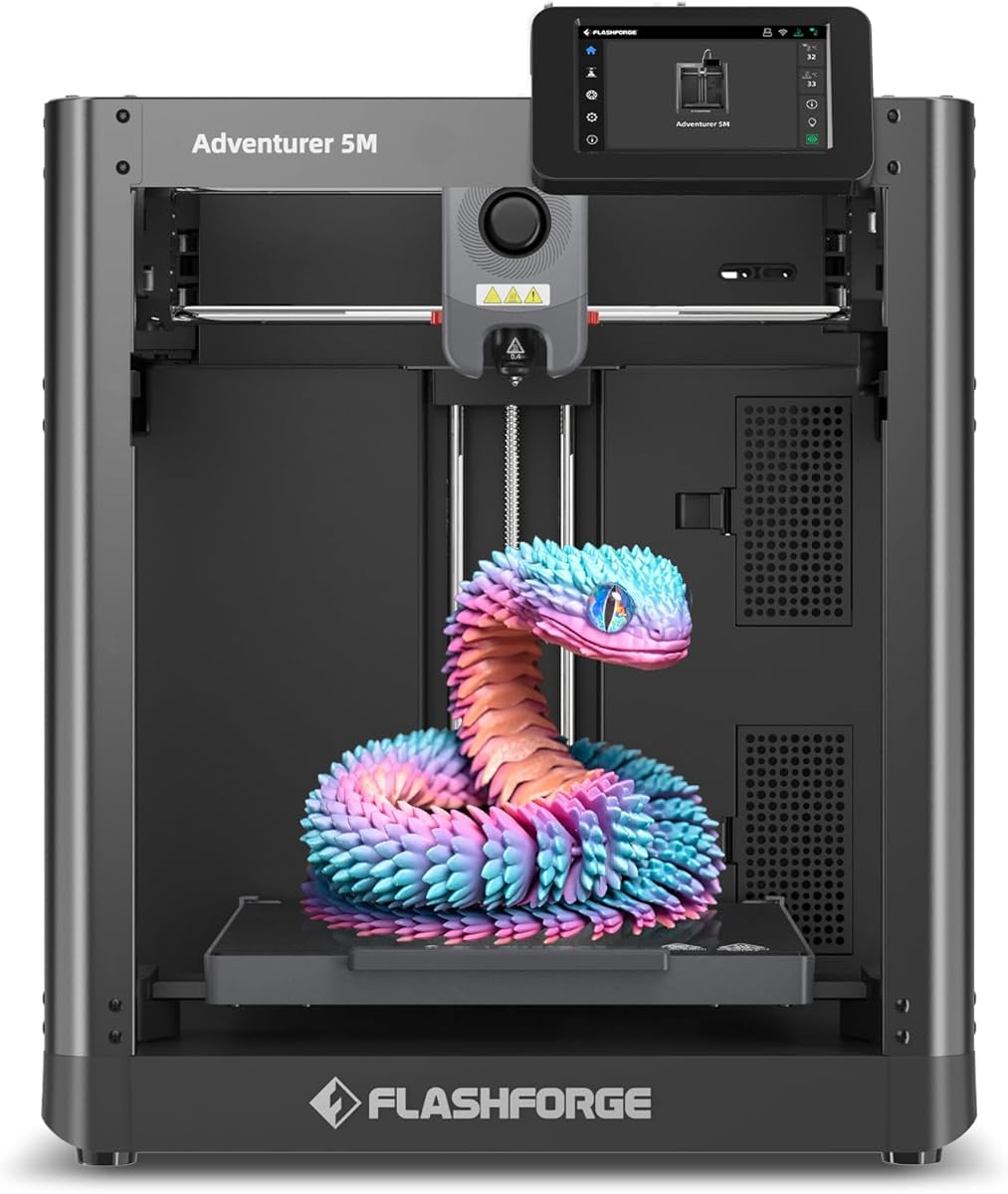
The FLASHFORGE Adventurer 5M stands out for its impressive speed and efficient design, making it suitable for rapid prototyping in advanced classrooms. It delivers a 3.9 rating with its 600mm/s travel speed and CoreXY all-metal structure.
We may earn a commission when you buy through this link, at no additional cost to you.
Features like one-click automatic printing and a high-flow nozzle reduce production cycles while ensuring consistent adhesion. Real-time app monitoring allows teachers to track progress remotely, saving valuable instructional time.
While it lacks an enclosure and has a lower rating than some competitors, its affordability and speed make it a strong choice for bulk printing needs. Users should note that it works best in well-ventilated environments.
Educators needing fast turnaround for multiple student projects should consider the 5M. Its quick setup and reliable auto leveling simplify the workflow, allowing more focus on design than maintenance.
Quick 3-second nozzle changes and fast warm-up times deliver stable high-speed printing for various projects.
The Flash Studio app lets you monitor print progress and receive status alerts anytime, anywhere.
We may earn a commission when you buy through this link, at no additional cost to you.
The Bambu Lab P1S brings professional-grade capabilities to educational settings with its fully enclosed design, earning a 4.5 rating. It is perfect for printing with advanced filaments like ABS and ASA that require temperature stability.
We may earn a commission when you buy through this link, at no additional cost to you.
Its 500mm/s print speed ensures students won't wait long for results, while auto bed leveling makes operation simple. Users can choose to connect the Bambu Lab AMS for vibrant multi-color prints, enhancing creative possibilities.
While the AMS adds to the cost, the base model's performance is robust. Some users may find the price higher than budget options, but the reliability and material support justify the investment for serious makers.
For schools needing to print a variety of durable materials, the P1S is an excellent choice. Its enclosed design improves success rates, and its user-friendly setup ensures quick adoption in any classroom.
The enclosed body improves performance for filaments like ABS and ASA while automatic leveling ensures high quality.
With 500mm/s speed and 20000 mm/s² acceleration, focus on creating rather than waiting for prints.
We may earn a commission when you buy through this link, at no additional cost to you.
The FLASHFORGE AD5M combines brand-new technology with superior craftsmanship to meet the needs of all users, earning a 4.3 rating. Its all-metal CoreXY structure ensures reliable, low-noise performance even at high speeds.
We may earn a commission when you buy through this link, at no additional cost to you.
Fully automatic one-click leveling precisely measures the nozzle distance to ensure a flawless first layer every time. The patent quick-release nozzle simplifies maintenance, while the flexible PEI plate makes model removal effortless.
Power outage recovery saves ongoing layers, reducing material waste in busy classrooms. While the Orca slicer and app offer advanced control, beginners may need time to learn all features. Overall, it is a versatile machine.
Students and experts alike will appreciate the AD5M's blend of speed and durability. It is an excellent choice for those looking for a reliable machine that can handle a wide range of creative projects.
The durable all-metal motion structure enables reliable performance and low noise even in high-speed mode.
If electricity shuts down, ongoing layers are saved and printing resumes from that point when restored.
We may earn a commission when you buy through this link, at no additional cost to you.
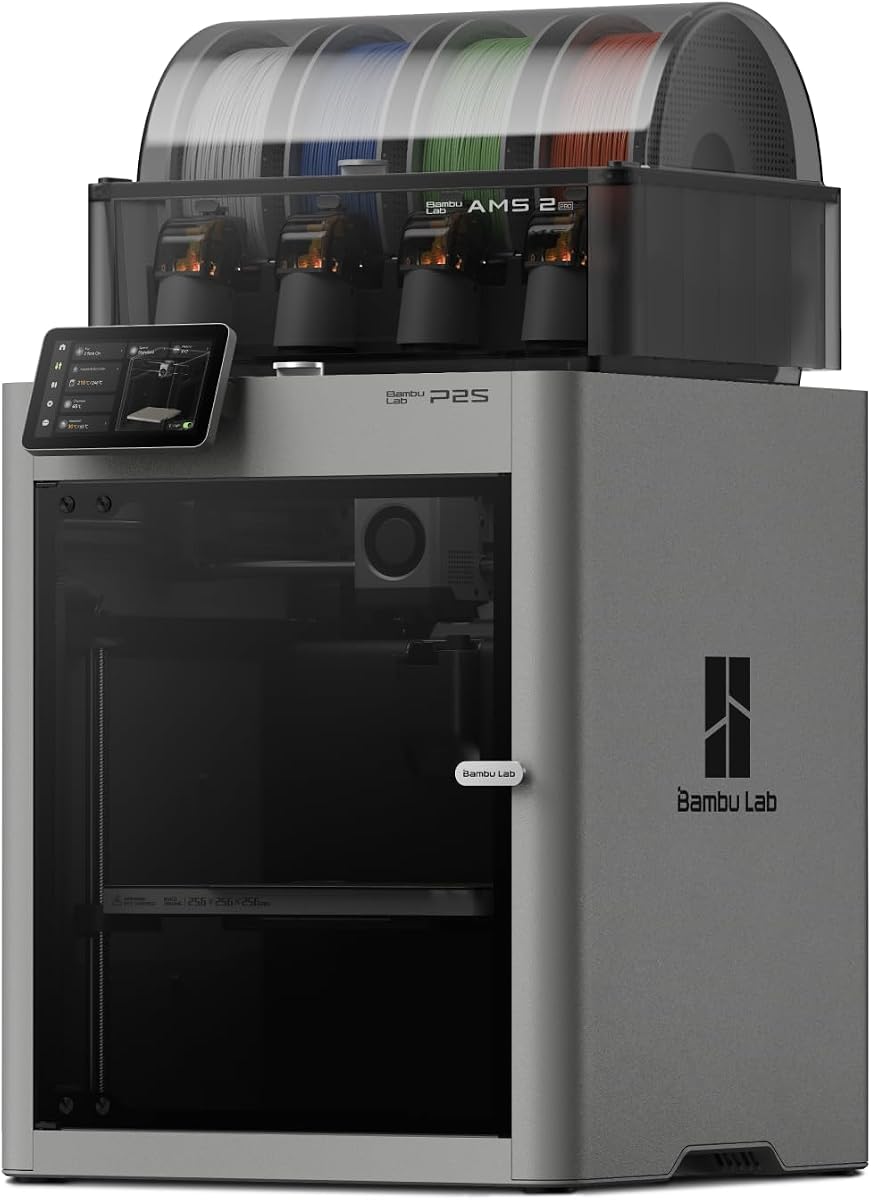
The Bambu Lab P2S Combo offers effortless multi-color printing with the AMS 2 Pro, earning a 4.7 rating for its professional capabilities. It prints up to 600 mm/s while maintaining exceptional accuracy with active flowrate compensation.
We may earn a commission when you buy through this link, at no additional cost to you.
The AMS 2 Pro includes built-in filament drying and supports over one million models on MakerWorld. Adaptive airflow balances cooling and heat retention, ensuring crisp overhangs and engineering-grade material performance.
While expensive, it is ideal for schools needing high-quality, multi-material projects. The AI failure detection and quick-swap nozzles reduce downtime, ensuring students can focus on creativity rather than troubleshooting.
Advanced educators looking for top-tier performance should consider the P2S Combo. It simplifies complex workflows and brings unlimited creativity into the classroom with seamless integration and reliability.
The AMS 2 Pro enables seamless multi-color printing with built-in filament drying and active flowrate compensation.
Balances cooling and heat retention to ensure crisp overhangs and engineering-grade material performance.
We may earn a commission when you buy through this link, at no additional cost to you.
The FLASHFORGE Adventurer 5M brings high-temperature capabilities to educational use, earning a 4.3 rating for its robust direct extruder. It features a 280°C nozzle and vibration compensation to eliminate ghosting in prints.
We may earn a commission when you buy through this link, at no additional cost to you.
Auto one-click leveling calibrates the bed properly, ensuring accurate and smooth surfaces. With filament run-out sensors and power-loss recovery, it eliminates common interruptions, allowing uninterrupted workflow in busy classrooms.
Although it is an open-frame printer suited for well-ventilated spaces, it is perfect for PLA, PETG, and TPU. Users should note that while it handles standard materials well, it may require careful management for engineering plastics.
Teachers needing high-temperature versatility without complex setups should choose the 5M. Its reliability and speed make it a practical choice for projects requiring consistent quality and minimal manual intervention.
Vibration compensation eliminates ghosting in prints while precise extrusion ensures smooth and no-blur results.
The open 3D printer is suitable for well-ventilated environments with flexible removable PEI steel plate support.
We may earn a commission when you buy through this link, at no additional cost to you.
The Snapmaker U1 offers true multi-material printing with four independent toolheads, earning a 4.5 rating for its advanced engineering. It enables switching between rigid, flexible, and soluble materials without manual intervention.
We may earn a commission when you buy through this link, at no additional cost to you.
With a 5-second tool changer and 500 mm/s speed, it reduces waste by up to 5X and accelerates project completion. The SnapSwap system ensures zero failures even after millions of swaps, making it ideal for prototypes.
While the price is higher, it is perfect for schools focusing on advanced engineering concepts. Users may find tool management complex initially, but the automatic calibration and remote app control simplify the workflow.
Educators needing to teach advanced multi-material concepts should consider the Snapmaker U1. It combines speed, reliability, and design freedom to inspire professional-level projects in an educational setting.
Combine rigid and flexible materials in a single print with four independent toolheads that switch automatically.
Automatic offset calibration and vibration compensation deliver smooth, dimensionally accurate prints with minimal adjustment.
We may earn a commission when you buy through this link, at no additional cost to you.
The Bambu Lab A1 Mini Combo brings multi-color printing to a compact package, earning a 4.2 rating for its efficiency. With 10,000 mm/s² acceleration, it delivers blazing-fast printing while maintaining exceptional accuracy for small projects.
We may earn a commission when you buy through this link, at no additional cost to you.
The AMS lite combo unlocks vibrant multi-colored prints, making it accessible for students to experiment with design. Its active motor noise cancellation ensures a quiet environment, and setup takes just 20 minutes.
While the build volume is smaller, it is perfect for desktop labs or individual student use. Some users may need to split larger models, but the reliable calibration and ease of use outweigh this limitation.
Educators with limited space should consider the A1 Mini for its balance of performance and size. It empowers students to explore creativity without requiring large dedicated areas for the printer.
Unlock creativity with vibrant multi-colored prints using the included AMS lite in a small footprint.
Enjoy a quiet environment with motor noise cancellation and a simplified touchscreen for easy operation.
We may earn a commission when you buy through this link, at no additional cost to you.
Selecting the right 3D printer for education involves balancing safety, cost, and learning tools. This guide highlights the essential factors to consider.
Safety is paramount in educational settings. Look for enclosures, cool-touch exteriors, and certifications like UL GREENGUARD. These features protect students from heat and fumes.
Prioritize models with safety certifications and enclosed designs for classroom use.
Time is valuable in schools. Choose printers that are fully assembled or require minimal setup. Auto-leveling and calibration features save educators from troubleshooting.
Select models with auto-calibration and quick setup to maximize teaching time.
Modern education relies on digital tools. Check if the printer supports user-friendly apps, cloud access, and slicing software. Some offer AI tools or guided tutorials for students.
Ensure the printer has intuitive software and app support for seamless learning.
Different projects need different filaments. Basic printers handle PLA well, but advanced needs may require PETG or ABS. Consider if the printer has a heated bed or enclosure.
Match the printer's material capabilities with your curriculum's project requirements.
Educational value is enhanced by tutorials, model libraries, or STEM modules. Brands like Entina and Ugee offer thousands of pre-made models and guided projects.
Choose printers with built-in libraries or partnerships with educational platforms.
Initial cost and ongoing maintenance are critical. Look for durable parts, quick-swap nozzles, and power-loss recovery. Cheaper models may save money upfront but cost more in wasted filament.
Balance the initial price with long-term maintenance needs and waste reduction features.
Speed matters for classroom projects. Faster printers reduce wait times, but ensure quality is not compromised. Features like auto-leveling and vibration compensation help maintain precision.
Select printers that offer a balance of high speed and consistent print quality.
Multi-color printing can enhance creativity but adds complexity. Some printers support this via add-on modules like AMS. Decide if this feature aligns with your educational goals.
Consider multi-color options if projects require detailed color differentiation.
Start by reading the manufacturer's guide. Most educational printers are plug-and-play, but you may need to level the bed or update firmware before the first print.
Use the provided app to upload models or select from built-in libraries. Adjust settings like layer height or infill based on the project's complexity and material.
Regularly clean the nozzle and check for clogs. Replace nozzles when worn and keep spare filaments on hand to prevent interruptions during class.
Yes, many models are designed with safety features like enclosures, cool-touch exteriors, and HEPA filters. Look for UL GREENGUARD certification to ensure low emissions and safe operation in enclosed spaces.
Most modern printers arrive pre-assembled and pre-calibrated. You can typically start printing within 8 to 20 minutes by plugging it in and following the app instructions.
No, most come with cloud-based apps that allow you to import or design models directly. Some also support popular slicers like Cura for more advanced customization.
PLA is the easiest to use due to its low melting point and minimal warping. It is safe and available in many colors, making it ideal for educational projects and experiments.
While one printer handles one job at a time, students can work on designs together or queue jobs. Some models support remote monitoring so others can start prints while one is finished.
Many models feature power-loss recovery to resume from the last layer. Use reliable power sources and check for filament levels to minimize interruptions during critical moments.
Not essential, but it adds creative possibilities. For most educational needs, single-color printing with assembly teaches similar skills. Multi-color is great for advanced projects or visual aids.
Clean the build plate after prints, replace nozzles when needed, and keep firmware updated. Store filaments in dry places and use maintenance tools to prevent clogs or jams.
Our top picks highlight the Bambu Lab A1 for overall performance, the Entina Tina2C for budget-friendly value, and the Ugee Funbox for safety and AI features. Each offers unique strengths for classrooms and home learning.
Prioritize safety and ease of use when making your selection. A model that minimizes setup and maximizes creativity will keep students engaged and teachers confident in the learning process.
Prices and features vary by model, so check current listings for the latest deals and bundles. Invest in a printer that aligns with your curriculum to foster the best learning outcomes.