
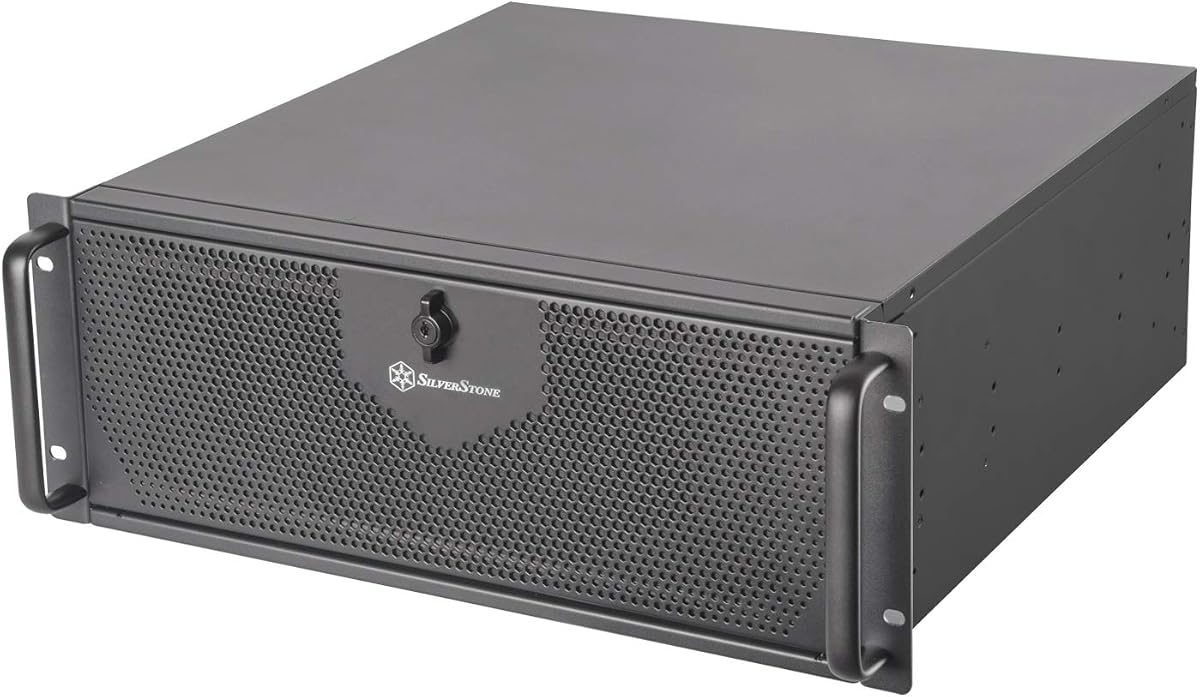
Silverstone Technology RM4A
3.6Editor score
Supports 360mm radiators easily
Includes one USB Type-C interface
Supports hard drive mounting on retainer
Finding the right enclosure for high-performance computing requires careful attention to thermal management and expansion capabilities. A solid chassis ensures your GPUs operate efficiently without thermal throttling during intense workloads like AI training or rendering tasks.
We evaluated ten leading models based on airflow design, motherboard compatibility, and drive bay configurations. Each option was selected for its ability to support multiple GPUs while maintaining stable operating temperatures in rack environments.
Every pick below highlights specific strengths and trade-offs to help you match hardware needs with physical constraints. Note that pricing fluctuates regularly so verify current costs before finalizing your procurement decision today.
3.6Editor score

4.3Editor score

As an Amazon Associate we earn from qualifying purchases.
The following table provides a side-by-side view of key specifications across all ten selected chassis models to help you quickly identify which design best fits your infrastructure requirements.


The SilverStone RM44 stands out as a top choice for users requiring advanced thermal management in a standard rack format. With its ability to accommodate 360mm liquid cooling radiators, it offers superior heat dissipation compared to air-only alternatives in dense compute environments.
We may earn a commission when you buy through this link, at no additional cost to you.
Its support for SSI-EEB and Extended ATX motherboards ensures compatibility with high-end server components while eight PCIe slots provide ample room for multiple GPUs or network cards. The inclusion of sliding rail mounting holes simplifies physical installation significantly.
Trade-offs include a higher price point than entry-level chassis and potentially complex cable routing when using both liquid and air cooling simultaneously. These are acceptable given the robust build quality and professional features aimed at enterprise workloads.
Ideal for data centers or AI labs needing reliable cooling for intensive GPU loads, this chassis balances flexibility and performance effectively. We recommend it for builders prioritizing thermal headroom and upgrade potential in a compact 4U form factor.
The support for large liquid cooling radiators allows for sustained high-performance computing without thermal throttling issues that plague standard air-cooled enclosures.
Eight full-height PCIe slots give users the freedom to add multiple accelerator cards or specialized I/O controllers as project requirements evolve over time.
We may earn a commission when you buy through this link, at no additional cost to you.
The RM4A offers a cost-effective entry point for those needing 4U rackmount capabilities with liquid cooling support. It maintains key specs like 360mm radiator compatibility while keeping the price accessible for smaller deployments or proof-of-concept builds.
We may earn a commission when you buy through this link, at no additional cost to you.
It supports SSI-EEB motherboards and provides eight PCI expansion slots alongside drive mounting options on the retainer. The USB Type-C interface adds modern connectivity convenience without significantly increasing the bill of materials.
However, user feedback suggests lower satisfaction regarding build rigidity and airflow optimization compared to premium counterparts. These trade-offs are acceptable for budget-conscious buyers who prioritize basic liquid cooling capability over advanced engineering.
This chassis is best suited for educational institutions or startups needing scalable hardware without breaking the bank. Choose it when you need a functional rack unit with liquid options but cannot justify high-end pricing tiers.
By focusing on essential liquid cooling features, this model delivers significant thermal benefits at a fraction of the cost of competing full-featured server chassis.
Eight PCI slots provide sufficient room for standard GPU or network card configurations in small server setups where extreme density is not required immediately.
We may earn a commission when you buy through this link, at no additional cost to you.
The ZhenLoong X412 targets users requiring maximum storage density alongside GPU support in a single rack unit. With twelve hot-swap bays and eleven expansion slots, it serves well for hybrid workloads combining heavy computation and massive data throughput.
We may earn a commission when you buy through this link, at no additional cost to you.
It includes dual 2000W power modules to handle high system consumption and supports U.2 NVMe SAS and SATA drives through its backplane. The guide rails simplify installation into standard 19-inch racks for quick deployment.
A significant consideration is the extended transportation cycle which may delay project timelines. Additionally, the lack of verified ratings means relying on specs rather than proven user experience for long-term reliability assessment.
Ideal for enterprise storage servers or render farms needing both compute and data capacity, this chassis offers unique value. Consider it if you need integrated power and high-density drive options without separate component procurement.
Including dedicated power modules ensures system readiness upon installation and reduces compatibility risks associated with selecting third-party PSU units for high-wattage needs.
Support for U.2 SAS and SATA drives allows flexible storage architectures adapting to different performance and cost requirements across various enterprise scenarios.
We may earn a commission when you buy through this link, at no additional cost to you.
This chassis excels as a versatile platform for SMBs requiring reliable storage and moderate GPU capability in a 4U rack form. Its hot-swap drive bays allow maintenance without system downtime ensuring continuous business operations.
We may earn a commission when you buy through this link, at no additional cost to you.
Support for EATX ATX MicroATX and Mini-ITX boards makes it adaptable to various server configurations. The included MiniSAS to SATA cables and user-friendly rail installation steps reduce setup complexity significantly.
While it supports up to 4 GPUs with cooling options, it may lack the extreme thermal headroom of dedicated GPU chassis. This is acceptable for mixed workload servers where storage access and general compute take priority over raw AI training density.
Recommend this for small businesses needing a flexible server base with easy storage management and future-proofing options. It balances cost and functionality well for environments where reliability and expandability are key drivers.
Hot-swappable drive bays ensure you can replace failing disks quickly without powering down the entire server minimizing downtime for critical applications.
Included MiniSAS cables and screwless rail options streamline the installation process reducing the need for specialized tools during initial deployment.
We may earn a commission when you buy through this link, at no additional cost to you.
The Rosewill RSV-AI01 is explicitly designed to handle intensive AI and machine learning tasks with up to four GPUs. Its intelligent storage and cooling systems ensure high performance and stability during long training sessions or data processing pipelines.
We may earn a commission when you buy through this link, at no additional cost to you.
Equipped with 8 hot-swappable SATA/SAS drives and advanced thermal management using hot-swap fans it supports continuous operation under heavy workloads. The USB 3.2 Type-C port adds high-speed data transfer capabilities for peripheral connections.
Trade-offs include a lower user rating that may indicate assembly challenges or specific hardware quirks. Additionally, the price point is higher than standard chassis so it is best reserved for specialized AI projects rather than general server use.
Ideal for AI researchers or developers needing a ready-made chassis for GPU clusters. Choose it when you want a case tailored for computational acceleration rather than generic server storage requirements.
Advanced thermal management with hot-swap fans maintains optimal temperatures ensuring stable operation when running multiple high-power GPU units simultaneously.
USB 3.2 Type-C and 3.0 ports ensure rapid data transfer and compatibility with modern peripherals essential for efficient system maintenance and monitoring.
We may earn a commission when you buy through this link, at no additional cost to you.
Supermicro delivers a premium chassis with perfect user ratings reflecting reliability and robust engineering. It optimizes for four double-width GPU solutions with eleven full-height expansion slots providing exceptional flexibility for enterprise deployments.
We may earn a commission when you buy through this link, at no additional cost to you.
Features include HDD door locks and side panel intrusion switches for physical security alongside extensive cooling with additional rear and middle fans. This build quality ensures long-term stability in demanding data center environments.
The main trade-off is the higher cost and substantial weight which requires a well-designed rack setup for safe installation. These costs are justified by the durability and security features critical for mission-critical workloads.
Best for large enterprises requiring maximum reliability and GPU density without compromising on security. We recommend this for organizations prioritizing performance longevity and physical security above all other factors.
Physical security features like intrusion switches and door locks protect sensitive hardware against unauthorized access or tampering in shared server rooms.
Optimized design for double-width GPUs allows high-density AI or rendering clusters within a standard 4U footprint maximizing rack space efficiency.
We may earn a commission when you buy through this link, at no additional cost to you.
This barebone system provides a complete platform for high-performance GPU computing with support for eight PCIe 5.0 GPUs and 32 DDR5 DIMM slots. Enhanced airflow ensures 600W GPUs and accelerator cards cool effectively during intensive workloads.
We may earn a commission when you buy through this link, at no additional cost to you.
It includes a 2700W redundant CRPS power supply and supports dual socket E2 processors for maximum compute power. The hot-swap NVMe and SATA/SAS drive bays offer flexible storage configurations tailored to server needs.
The main consideration is the high price point and lack of verified reviews which requires careful evaluation of your infrastructure requirements. These are acceptable for specialized deployments needing immediate high-end capacity.
Ideal for AI training clusters or scientific computing requiring maximum throughput and redundancy. Choose this when you need a pre-configured high-power environment without sourcing individual components.
Support for eight PCIe 5.0 GPUs and ample memory slots ensures your system remains future-proof for next-generation computational accelerators and large datasets.
Dual 2700W redundant power modules ensure continuous operation even if one unit fails preventing downtime in critical compute scenarios.
We may earn a commission when you buy through this link, at no additional cost to you.
This AMD-optimized chassis supports EPYC 9005 processors with 12+12 DIMM slots and massive cooling capacity for GPU accelerators. It stands out with 16 hot-swap NVMe bays supporting PCIe 5.0 x4 speeds for lightning fast storage access.
We may earn a commission when you buy through this link, at no additional cost to you.
Power is supplied by a 3200W CRPS ensuring adequate headroom for eight full-height GPU solutions without bottlenecks. Enhanced airflow design specifically targets reliable cooling for high TDP accelerator cards in dense configurations.
The primary trade-off is the extreme cost and specialization for AMD architecture limiting general applicability. These costs are justified for organizations committed to EPYC ecosystems needing maximum GPU density and storage performance.
Best for large data centers utilizing AMD EPYC CPUs with heavy GPU workloads. Select this when performance and storage speed outweigh initial budget concerns for mission-critical infrastructure.
Designed specifically for AMD EPYC 9005 processors ensures compatibility with the latest high-core count CPUs for maximum computational efficiency.
Sixteen hot-swap NVMe bays with PCIe 5.0 support deliver unmatched storage bandwidth essential for large datasets in AI and HPC applications.
We may earn a commission when you buy through this link, at no additional cost to you.
This chassis offers a balanced approach for GPU and storage requirements supporting 8 FHFL GPUs and 24 DDR5 DIMM slots for heavy computational loads. It includes 4 hot-swap NVMe bays and 20 SATA bays for flexible data management.
We may earn a commission when you buy through this link, at no additional cost to you.
Enhanced airflow maintains reliable cooling for 600W GPUs while a 2700W Titanium CRPS ensures energy efficiency and stable power delivery. Dual Socket SP5 support allows for advanced AMD processors with high core counts.
Trade-offs include the niche processor support and high cost which limits this to specialized enterprise deployments. These are acceptable for users needing both high GPU compute and significant local storage capacity.
Ideal for AI inference servers or rendering farms needing balanced compute and storage. Consider this when you require specific AMD architecture compatibility alongside high GPU and RAM capacity.
Combining high GPU support with substantial storage bays allows this chassis to handle mixed compute and data processing tasks efficiently.
The Titanium rated CRPS ensures maximum power efficiency reducing operational costs during long-running compute tasks.
We may earn a commission when you buy through this link, at no additional cost to you.
With a 4.7 rating this Silverstone chassis stands out for reliability and thoughtful features like anti-theft lock design for physical security. It supports SSI-EEB motherboards and liquid cooling up to 240mm radiators for effective thermal management.
We may earn a commission when you buy through this link, at no additional cost to you.
The front panel security features and USB Type-C interface add practical value for shared rack environments. Sliding rail mounting holes allow quick installation whether placed horizontally or vertically depending on space constraints.
Trade-offs include smaller radiator support compared to 360mm models and fewer expansion slots for extreme GPU needs. These are acceptable for general server use where security and cooling are priorities over massive density.
Ideal for secure server rooms or offices needing reliable liquid cooling and physical protection. Recommend this when you value build quality and security features alongside standard rackmount functionality.
Anti-theft lock design protects valuable hardware from unauthorized access making it suitable for public or shared server locations.
Options to place upright or horizontal give you adaptability for various rack configurations without compromising airflow or cooling performance.
We may earn a commission when you buy through this link, at no additional cost to you.
Selecting the right chassis requires evaluating multiple technical factors to ensure your hardware operates reliably under load.
Effective cooling is the most critical factor for GPU servers as heat density can quickly exceed standard air cooling limits. Look for chassis supporting high RPM fans liquid cooling loops or hybrid systems designed to dissipate heat from multiple GPUs simultaneously. Ensure airflow paths are optimized to prevent recirculation of hot air back into components.
Prioritize models with high fan capacity and support for larger radiators if you plan to run sustained compute workloads.
Verify the number of full-height full-length PCIe slots available to accommodate your intended GPU count. Some chassis offer optimized spacing for double-width cards while others support narrow profile cards. Ensure the physical depth of the chassis fits the length of your GPUs without hindering airflow.
Check expansion slot count and layout to confirm you can install enough GPUs and add-on cards without mechanical conflicts.
Ensure the chassis supports your chosen motherboard form factor whether ATX MicroATX or Extended ATX. Larger E-ATX boards offer more PCIe lanes but require chassis with specific cutouts and standoff locations. Verify standoffs and rear panel alignment to avoid installation issues.
Choose a chassis that matches your motherboard size to avoid wasted space or unsupported mounting options.
High GPU counts require robust power supplies often exceeding standard wattage. Look for chassis supporting CRPS redundant power units or multiple ATX PSUs to ensure stable power delivery. Check wattage limits and connector availability for high-power accelerators.
Ensure the PSU configuration meets your system wattage needs and supports redundancy for uninterrupted operation.
Determine the number and type of drive bays you need for data storage and caching. Hot-swap bays allow drive replacement without downtime which is crucial for enterprise environments. Verify backplane support for SAS SATA or NVMe drives as required.
Match drive bay counts and types to your data retention and access speed requirements.
Enterprise environments often require physical security features like front panel locks and intrusion switches. Sturdy alloy steel construction ensures durability during transport and rack installation. Check for anti-theft designs and robust side panels to protect hardware assets.
Prioritize security features if the server will be located in shared or accessible areas.
Look for chassis with pre-installed rails or included rail kits to simplify mounting into 19-inch racks. Screwless rail installation reduces setup time and tool requirements. Ensure the rails support the full weight of your assembled system securely.
Choose models with reliable rail kits to avoid mechanical stress during installation or use.
Modern chassis should include USB Type-C or USB 3.0 ports on the front panel for quick peripheral access. Ensure rear IO panels align with your motherboard layout to allow cable routing without interference. Consider internal header availability for additional management cards or controllers.
Verify front and rear connectivity matches your needs for maintenance and system management.
Install all GPUs and components ensuring proper standoff alignment before mounting rails. Secure the chassis into the rack using the included hardware and verify stability. Connect power and data cables ensuring hot-swap drive connections are fully seated.
Monitor temperatures regularly using system management tools to ensure cooling fans are functioning correctly. Clean dust filters and fans every quarter to maintain optimal airflow and prevent overheating. Replace fans if noise increases or performance drops.
Schedule regular checks on power supply units for signs of wear or fan noise. Tighten screws and mounting hardware annually to prevent loosening from vibration. Follow manufacturer guidelines for fan replacement and cable management to extend hardware lifespan.
EATX boards are wider and offer more PCIe slots which is ideal for multi-GPU setups. A 4U chassis must have specific cutouts for EATX mounting. Ensure your chassis supports EATX if you plan to use extended boards.
Liquid cooling provides better heat dissipation for dense GPU loads. Many 4U chassis support 360mm radiators for this purpose. If running high-end GPUs continuously liquid cooling prevents throttling effectively.
Most enterprise 4U chassis support CRPS units for redundancy. Check specific models for compatibility. CRPS power ensures uptime if one unit fails during critical operations.
A 4U chassis typically supports 4 to 8 GPUs depending on thickness. Double-width cards reduce count. Look for optimized slots for your specific GPU models to maximize density.
Many models include hot-swap bays for quick maintenance. Verify if your model supports SAS SATA or NVMe drives. Hot-swap drives reduce downtime during repairs.
Intrusion switches alert admins if the chassis is opened. This prevents unauthorized access to sensitive hardware. Essential for secure data center environments.
Install inner rails on the chassis then outer rails on the rack. Slide the chassis into rails until locked. Use the provided tools and guides for proper alignment.
These chassis often weigh 30 to 60 pounds empty. Add weight for components. Ensure your rack is sturdy enough to support the load.
We reviewed ten top chassis ranging from budget-friendly options to enterprise-grade GPU platforms. Each offers unique strengths in cooling expansion and storage to suit different deployment scales.
Prioritize thermal management and expansion slots if you plan to scale GPU workloads. For security and reliability, look for models with intrusion switches and redundant power.
Prices and stock change frequently so always verify current specs before purchase. Selecting the right chassis now ensures your server infrastructure remains stable for years.