
OWON DGE2035
4.2Editor score
35MHz frequency range
125MSa/s sampling rate
Clear TFT LCD display
This guide compares the top Amfm Signal Generator models for precision testing, modulation features, and reliability across engineering and hobbyist application
Selecting the right Amfm Signal Generator is essential for engineers and enthusiasts who need reliable signal sources for testing circuits and radio equipment. These devices produce precise waveforms with modulation capabilities that simulate real-world conditions accurately. A high-quality generator ensures your measurements are accurate and your designs perform as expected under various stress tests.
We evaluated ten top-rated models based on frequency range, modulation types, output stability, and user interface design. Our analysis includes detailed specs and real-world application scenarios to help you find the perfect fit for your lab or field work. Each product offers unique strengths whether you need broad RF coverage or precise waveform control.
Each pick in this list highlights specific strengths and limitations so you can make an informed decision without guesswork. Note that availability and pricing may fluctuate over time so verify current details before purchasing. We aim to provide clear insights that save you time and ensure you invest in equipment that meets your technical requirements reliably.
4.2Editor score

5.0Editor score

5.0Editor score
This comparison table provides a side-by-side overview of the ten leading Amfm Signal Generator models available today. We highlight key specifications like frequency range, modulation support, and channel count to help you quickly identify the model that fits your specific testing needs and budget constraints effectively.




The UNI-T UTG962E stands out as a top-tier Amfm Signal Generator for professionals needing reliable dual-channel waveform generation. With a 60 MHz max frequency and 200 MS/s sample rate it delivers precise signals for complex circuit testing. Its compact handheld form factor makes it ideal for fieldwork while maintaining lab-grade performance standards.
We may earn a commission when you buy through this link, at no additional cost to you.
This model excels in modulation capabilities supporting AM FM and PM modes out of the box. Users can store up to 24 non-volatile digital arbitrary waveforms for diverse applications without external software. The scan functionality allows linear and logarithmic types ensuring comprehensive signal analysis across different frequency ranges efficiently.
While the 60 MHz limit may not suit ultra-high RF needs it covers most electronics and hobbyist requirements well. The mini size is convenient but the screen is small for detailed waveform inspection compared to benchtop units. These trade-offs are acceptable given the value and portability it offers to engineers on the move.
Ideal for enthusiasts and engineers who need a versatile tool for signal analysis and component testing. The inclusion of USB connectivity and power adapters ensures quick setup. We recommend this unit for anyone seeking a balance between performance and portability in an Amfm Signal Generator package.
Supports sine square ramp pulse noise and DC waveforms for comprehensive testing scenarios across multiple channels simultaneously.
Easy-to-use modulation types include AM FM PM and FSK making it suitable for radio testing and communication system validation.
We may earn a commission when you buy through this link, at no additional cost to you.
The OWON DGE2035 offers an excellent entry point for those seeking a capable Amfm Signal Generator without breaking the bank. It delivers 35 MHz output with a 125MSa/s sampling rate and 14-bit resolution for stable and precise signal generation. The 3.6 inch TFT LCD provides a clear view of real-time waveform status and menu settings.
We may earn a commission when you buy through this link, at no additional cost to you.
Users benefit from 150 built-in arbitrary waveforms alongside five standard ones like sine and square. Advanced features include AM FM PM and FSK modulation plus sweep mode and burst function for complex testing. PC control via USB allows for remote operation which is great for integrated lab setups and automated testing.
The ultra-thin design and shortcut keys make it highly portable and easy to operate even for less experienced users. However the frequency ceiling is lower than some competitors and the resolution may not meet ultra-precise industrial standards. These limitations are minor considering the value proposition for education and general electronics work.
Perfect for research labs educational training and industrial testing where budget constraints exist. It balances features and cost effectively making it a strong contender in the affordable segment. We suggest this model for students and hobbyists needing reliable dual-channel output and modulation support.
Supports dual-channel output with up to 8K arbitrary waveform length ensuring flexible and stable signal generation for detailed tests.
Clear TFT color screen displays real-time waveform status and menu settings with shortcut keys for quick access to functions.
We may earn a commission when you buy through this link, at no additional cost to you.
The SEESII Dual Channel 30MHz DDS Signal Generator represents a premium choice for engineers needing rigorous testing capabilities. It features fully independent equal-performance dual channels allowing phase difference adjustment from 0 to 359.9 degrees. This enables dual-channel synchronous and differential circuit testing with high precision and low distortion.
We may earn a commission when you buy through this link, at no additional cost to you.
Covers 0.01μHz to 30MHz frequency with 266MSa/s sampling rate and 14-bit resolution to ensure repeatable test results. It includes 60 built-in arbitrary waveforms and pulse width regulation for fine duty cycle control. The unit integrates seven devices into one including a frequency meter and counter to save desktop space.
While the advanced features make it powerful they may overwhelm beginners needing simple outputs. The cost is higher than basic models but justified by the versatility and accuracy. This model is ideal for R&D and university labs where precise waveform control is critical for success.
Recommend for engineering R&D factory inspection and design competitions. The complete package with cables and adapters means immediate use out of the box. It is a robust tool for professionals demanding high fidelity and flexibility in their signal generation tasks.
Two equal-performance channels can output same or different waveforms with fully independent parameter adjustment for advanced testing.
Integrates function arbitrary waveform pulse noise frequency meter counter and sweeper into one device effectively reducing equipment cost.
We may earn a commission when you buy through this link, at no additional cost to you.
This 6-Band Signal Generator offers a broad frequency range from 100KHz to 150MHz suitable for extensive radio and lab testing. Its low phase noise characteristics ensure signal purity reducing interference and errors in high-quality testing environments. The sturdy metal and plastic spraying process make it impact-resistant and corrosion-free for long service life.
We may earn a commission when you buy through this link, at no additional cost to you.
The design focuses on simplicity with clear markings and a convenient knob for quick operation. It supports multiple modulation methods including AM and FM allowing users to choose types based on actual needs. The one-piece structure requires no assembly so you only need power and test clips to start operating immediately.
While it lacks a detailed digital screen the analog simplicity can be advantageous for straightforward signal checks. Users looking for advanced waveform control might find it limiting but it excels in RF coverage. The durability and ease of use make it a practical choice for maintenance and basic field testing.
Ideal for equipment maintenance and lab work where signal quality and durability are prioritized. The wide frequency range covers many common RF applications effectively. We recommend this for technicians needing a reliable RF source without complex digital interfaces or setup requirements.
Excellent low phase noise characteristics effectively ensure the purity of the signal and reduce interference for accurate testing.
High-class metal and plastic process make the product sturdy scratch-resistant and not easy to deform over time.
We may earn a commission when you buy through this link, at no additional cost to you.
The Upgraded RF Signal Generator extends coverage up to 4400MHz making it suitable for advanced RF applications beyond standard bands. It supports both single frequency and sweep mode offering greater flexibility for signal analysis. The device remembers parameters after power off so it resumes at the previous frequency automatically.
We may earn a commission when you buy through this link, at no additional cost to you.
It operates on a sine wave basis with about 1mw power output which fits many testing needs. The power supply is convenient relying on a mobile charger or USB connection to a computer. This makes it highly portable for field technicians needing wide range capability without heavy benchtop units.
However the waveform quality may include some noise wave variations that could affect precision sensitive measurements. The screen is basic and may lack detailed visualization for complex signal analysis. These factors are acceptable trade-offs for the sheer frequency range and portability it provides to RF professionals.
Best for applications requiring ultra-high frequency coverage up to 4.4GHz. It serves well for signal source kit needs where simplicity and range matter most. We suggest this for users prioritizing frequency reach over precise waveform purity in their testing scenarios.
Wide frequency range from 35Mhz to 4400Mhz makes it suitable for a variety of high-frequency applications and testing.
Convenient power supply by mobile charger or Power bank or USB connecting to a computer for easy portability.
We may earn a commission when you buy through this link, at no additional cost to you.
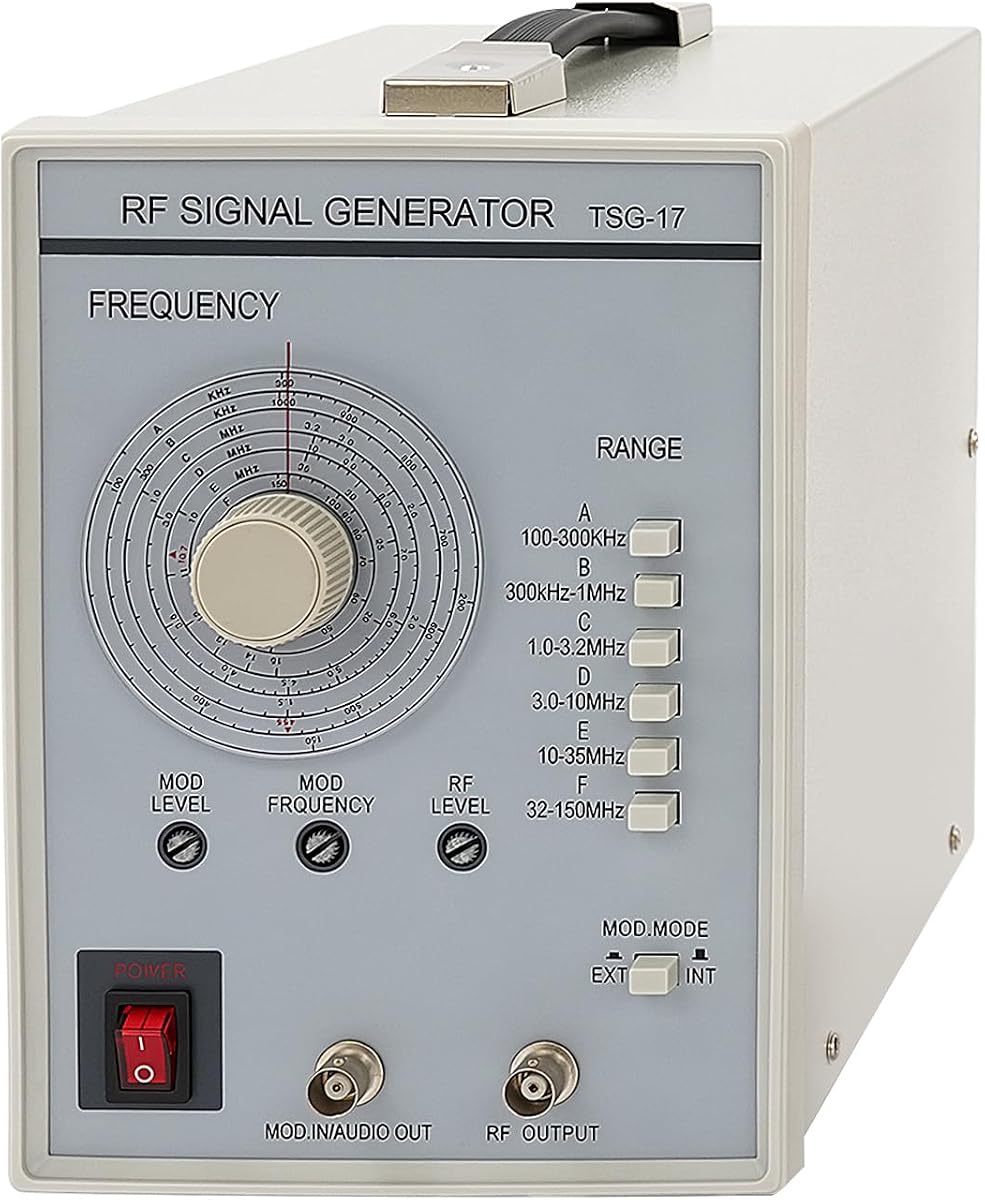
The TSG-17 High Frequency RF/AM Signal Generator is designed for commercial and household use with a focus on high accuracy. It covers a frequency range from 100 kHz to 150MHz with three harmonics extending up to 450MHz. Output control ranges from 1mV to 100mV measured from the output terminal for flexible testing.
We may earn a commission when you buy through this link, at no additional cost to you.
RF and AM outputs can reach a minimum of 100mv rms up to 35Mhz unloaded. External modulation signals can be set between 50Hz to 20 KHz allowing for custom modulation inputs. The unit includes a power cord for standard 110V operation which simplifies setup in fixed locations.
While it aims for high accuracy the overall user ratings suggest mixed experiences with stability or interface. The waveform options are primarily sine and amplitude modulation which may limit advanced users. It remains a functional option for basic AM radio testing and commercial signal verification tasks.
Best suited for commercial applications where standard RF and AM signals are required. The frequency range covers many common testing needs for maintenance and repair. We recommend this for users needing a dedicated 110V unit with basic modulation capabilities for routine checks.
Output control from 1mV to 100m measured from output terminal ensures flexible signal strength for different test requirements.
External modulation signal can be set between 50Hz to 20 KHz for custom input testing scenarios.
We may earn a commission when you buy through this link, at no additional cost to you.
This Adjustable Signal Generator provides both current and voltage outputs making it versatile for industrial signal simulation. It features a built-in 3.7V lithium battery with 1500mAh capacity for portable operation away from wall outlets. Voltage output can be set from 0 to 12V while current output supports 0 to 24mA with high accuracy.
We may earn a commission when you buy through this link, at no additional cost to you.
The PWM output allows frequency adjustment from 1 to 150 kHz with duty cycle control. It includes short circuit and reverse connection protection for safe use in various environments. The device stores output values when power is off so settings are retained without reconfiguration.
However the PWM output is not applicable to certain 12V or 2V systems due to voltage level constraints. Battery life varies depending on load size typically offering 1 to 5 hours of use per charge. These limitations are manageable for most field calibration tasks and maintenance work.
Ideal for calibration tasks and testing electrical systems requiring precise current or voltage signals. The portability and protection features make it a reliable choice for technicians. We suggest this for field engineers needing a compact tool for signal loop testing and adjustment.
Built-in 3.7V lithium battery with 1500mAh capacity allows use for 1-5 hours depending on output load size.
Includes short circuit protection reverse connection protection and charging protection to ensure safe operation in varied settings.
We may earn a commission when you buy through this link, at no additional cost to you.
The Riiai 0-10V 0/4-20mA Current Voltage Signal Generator offers a 2-in-1 solution for voltage and current simulation. It supports voltage output from -10V to +10V with precision of 0.01V and current output 0 to 22mA with similar precision. The 4-digit display allows switching between voltage current and other modes via a mode button.
We may earn a commission when you buy through this link, at no additional cost to you.
Power can be supplied via micro USB 5V or external DC 15-30V adding flexibility for field use. The device includes a 1000mAh rechargeable battery for standalone operation. Output protection features include short circuit and reverse connection safety which protects connected devices during testing.
While the voltage range is limited compared to industrial standards it suits most panel and PLC debugging needs. The encoder knob adjustment is smooth but the micro USB charging may feel dated. These are minor issues given the overall utility and cost-effectiveness for small-scale testing.
Perfect for PLC panel debugging device testing and servo motor speed regulation. The small size ensures easy transport for on-site work. We recommend this for technicians needing a reliable and compact tool for analog signal calibration and verification tasks.
With 4 different types of digit displays and two decimal points you can switch modes easily for clear reading.
Output range and precision are programmable and adjustable with short circuit protection for safe use.
We may earn a commission when you buy through this link, at no additional cost to you.
The Riiai SG003A is an upgraded 4-20mA signal generator that supports multiple signal types including current voltage and pulse. Its 2.4 inch TFT colorful screen with backlight allows clear operation day or night. A built-in 3000mAh USB rechargeable battery provides up to 26 hours of working length for extended field sessions.
We may earn a commission when you buy through this link, at no additional cost to you.
It includes multiple interfaces for input waveform graphs VCA conversion and automatic modes like ascent and cycle. The programmable output allows continuous changes based on set parameters. This flexibility makes it ideal for PLC testing and industrial automation debugging where signal simulation is routine.
While the interface may seem complex at first the real-time curve display simplifies monitoring. The battery life is impressive but recharging takes 4 to 6 hours. These trade-offs are acceptable for a tool that combines so many functions in a compact portable package.
Ideal for PLC testing factory electronic inspection and maintenance scenarios. The multiple signal types reduce the need for separate devices. We recommend this for engineers needing a comprehensive analog simulator with robust battery life and clear visual feedback.
Precise conversion of various signal types like mA Current V Voltage and XMT Passive Current Signal supports diverse testing needs.
Built-in 3000 mAh USB Rechargeable battery allows working length of up to 26 hours for extended use.
We may earn a commission when you buy through this link, at no additional cost to you.
The DROK signal generator kit is a multifunctional tool capable of generating both ampere and voltage signals from one module. It produces 0/4 to 20mA current signals and 0 to 10V voltage signals using a multi-cycle precise potentiometer. This setup is simple and handy for value adjusting and testing panels without complex electronics.
We may earn a commission when you buy through this link, at no additional cost to you.
The control relies on rotating a knob rather than digital menus which speeds up quick adjustments during testing. It is compact and lightweight making it easy to carry for field repairs or maintenance. This device is specifically designed for valve adjusting PLC panel and LED testing scenarios.
While it lacks a digital display the analog control provides tactile feedback valued by some technicians. It does not support complex waveform or modulation options but excels in basic signal simulation. The simplicity ensures reliability and ease of use for standard industrial checks.
Best for users needing a straightforward and reliable analog simulator for basic testing. The potentiometer control allows quick changes without menu navigation. We recommend this for technicians focused on value adjusting and routine PLC panel checks where simplicity is preferred.
Amp and volt dual signal generator kit generates 0/4-20mA current signal and 0-10V voltage signal just by rotating a potentiometer.
Simple and handy design with precise potentiometer control allows quick adjustments during PLC panel testing efficiently.
We may earn a commission when you buy through this link, at no additional cost to you.
Choosing the right Amfm Signal Generator involves balancing technical specs with your application needs. This guide covers the essential factors to consider before making your purchase decision.
The frequency range defines the lowest and highest signals your generator can produce. For standard electronics work a range up to 60MHz may suffice but RF testing often requires higher limits like 150MHz or beyond. Always check if the maximum frequency meets your specific test requirements.
Select a frequency range that covers your typical testing scenarios to avoid limitations during critical experiments.
Modulation capabilities like AM FM and PM are crucial for simulating real-world radio and communication signals. Some generators include FSK and pulse width modulation for broader applications. Ensure the model supports the modulation types needed for your testing protocols.
Look for comprehensive modulation support to ensure compatibility with various signal testing standards.
Dual channel generators allow you to test two signal paths simultaneously or compare phase differences. Single channel models are simpler and cheaper but lack this flexibility. Choose based on whether you need parallel testing capabilities for your projects.
Opt for dual channel models if your work requires simultaneous signal generation for accurate comparisons.
Field technicians need handheld or lightweight devices that can run on battery power. Benchtop units offer more stability but are less convenient for mobile work. Evaluate the size and battery options to ensure the unit fits your environment.
Prioritize portable designs if you need to move the generator between different testing sites regularly.
High resolution and low phase noise ensure the signals generated are accurate and stable. Precision is critical for calibrating sensitive equipment where small errors matter. Look for specifications like 14-bit resolution or specific accuracy metrics.
Choose models with high precision specs to ensure reliable and repeatable testing results.
User interfaces vary from physical knobs to touchscreens and menus. Clear displays help visualize waveforms and settings quickly. Consider your comfort with digital menus versus analog controls when selecting a unit.
Select an interface that allows easy operation without excessive steps for efficient workflow.
USB connectivity enables remote PC control which is useful for automated testing. Some units support external modulation inputs for more complex scenarios. Ensure the connectivity options match your lab infrastructure.
Look for USB or external inputs if you need automated or custom signal modulation setups.
A sturdy metal or high-quality plastic housing protects against impact and environmental factors. Long service life depends on robust construction especially for field use. Check build materials and protective features like short circuit protection.
Invest in durable build quality to ensure the generator withstands daily use over years.
Start by connecting the generator to a stable power source or charging the internal battery. Use the provided cables to link the output to your device under test securely. Verify all connections match the signal type and impedance requirements to prevent damage.
Select the desired waveform and frequency using the interface controls or digital menus. Adjust output voltage and amplitude gradually while monitoring connected equipment to avoid surges. Use modulation settings only when needed to simulate specific signal behaviors accurately.
After testing power down the unit properly and disconnect cables carefully to avoid wear. Store the device in a dry and dust-free environment to maintain performance. Regularly check for firmware updates if your model supports them to keep features current.
An Amfm Signal Generator is primarily used to produce precise electronic signals that simulate real-world conditions for testing. Engineers use these devices to validate circuits radio equipment and communication systems under various modulation and frequency settings. It helps ensure designs function correctly before deployment in practical scenarios.
Yes hobbyists can benefit from affordable Amfm Signal Generators to test radios and audio circuits. Many models offer features like multiple waveforms and modulation suitable for home electronics work. They provide a professional-grade way to debug and experiment without costly alternatives.
A function generator typically covers lower frequencies up to 60MHz while an RF generator extends into higher bands. The RF unit is optimized for radio frequency testing with better stability at high frequencies. Choose based on whether your work involves standard electronics or wireless communication testing.
Many modern Amfm Signal Generators support digital modulation modes like FSK and pulse width modulation. Check the specs to confirm if your model includes these advanced options. Some units require PC software to enable full digital waveform capabilities effectively.
Channel count determines if you can test multiple signal paths at once or compare phase differences easily. Dual channels are vital for complex circuit testing where signal interaction matters. If you only need one output at a time a single channel model may suffice.
Many portable models include built-in lithium batteries for field use without wall power. These allow several hours of operation depending on output load and settings. Verify battery capacity before purchasing if mobility is a priority for your work.
The top picks in this guide highlight diverse options from portable budget units to premium precision tools. The UNI-T UTG962E offers a balance of performance and portability while the OWON DGE2035 provides excellent value for basic needs. The SEESII Dual Channel stands out for advanced engineering tasks requiring high fidelity.
When choosing prioritize frequency range and modulation support based on your specific testing requirements. Consider durability and portability if you work across multiple locations often. Selecting the right features ensures you do not overspend or underperform on critical projects.
Remember that pricing and availability may change so verify current details before purchasing. Check for any bundle accessories like cables that add value to your purchase. We hope this guide helps you find the perfect Amfm Signal Generator for your professional or hobby needs.